

Chasing your dreams isn’t just about ambition; it’s about planning and taking actionable steps. In the world of financial planning, goal setting acts as the roadmap that guides every decision you make with your money. Without clearly defined financial goals, it’s easy to lose direction, make impulsive decisions, or fall short of the life you envision.
Goal setting is a crucial part of financial planning because it gives you direction and clarity on how to manage your money effectively. By setting clear financial goals, you can make smarter decisions, stay motivated, and work steadily toward long-term financial success.
Setting milestones allows you to track progress, measure success, and stay motivated, even when challenges arise. Over the years, I’ve seen that people who write down their financial goals and plan strategically are far more likely to achieve them, turning their dreams into reality.
Understanding Why Goal Setting Is Important in the Financial Planning Process
This year there was a huge push not to set goals. People were sharing about how terrible they felt last year when they failed to meet their goals or how they never really followed through with achieving them. So should we even set goals to try to see our dreams come true? YES! The problem for so many people is that they haven’t created goals which will help them succeed.
And their inability to follow through because of fear or poor goal creation holds them back. This was me about ten years ago. I would set goals at the beginning of the year and then never go back and look at them. I would have these really vague general ideas of things I wanted to accomplish but never create action steps or any plans to achieve anything.
This is why goals fail. You have probably heard of the SMART goal system. This is a great system. In fact when I finally got tired of never accomplishing my goals I learnt about it and started to see some of my goals achieved. And then I learned about the “ER” in goal setting.
The SMARTER Goal System Explained
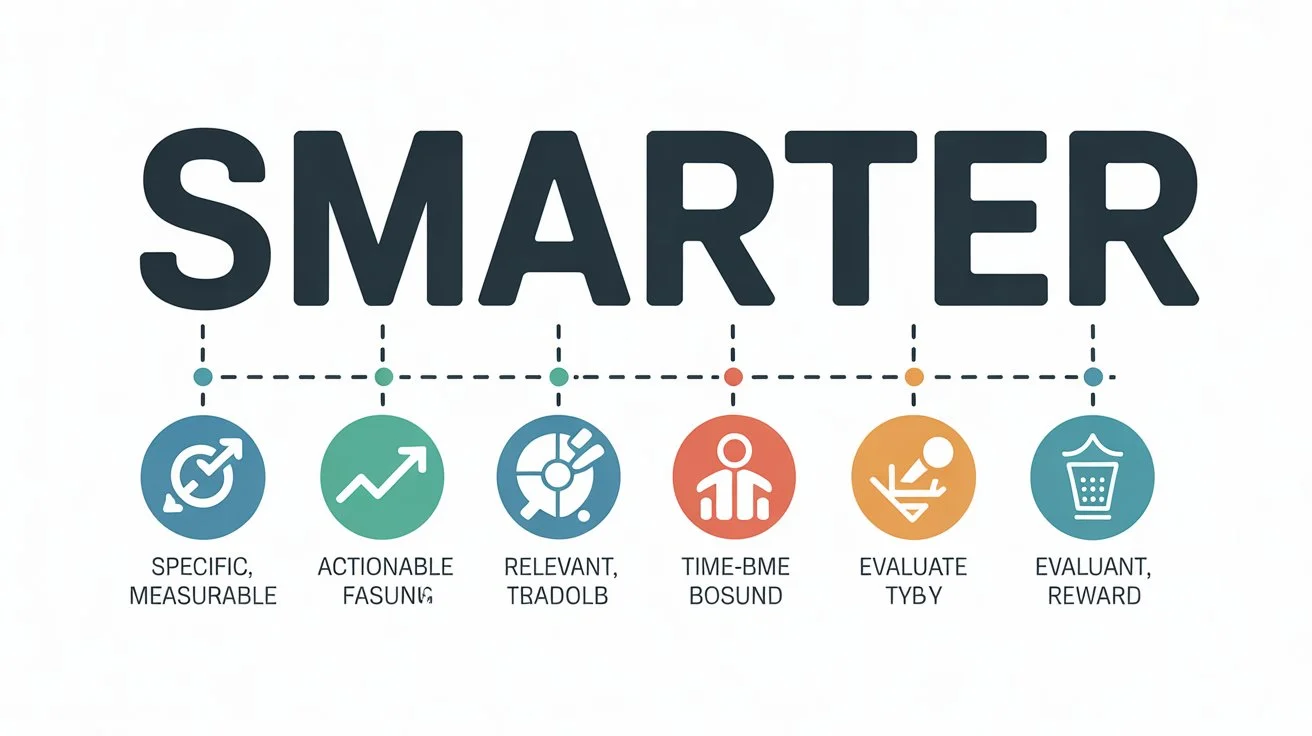
Let’s start putting some goals together using the SMARTER System.
S – Specific: Get Crystal Clear
Specific – Sounds pretty simple right? Just write something down that is specific. The question is how specific do I need to be? The answer is the more specific you are the easier it will be to quantify your results along the way. For example if you want to lose weight, to be more specific how much weight do you want to lose? Better yet what weight would you want to be at the end of pursuing your goal? A specific goal says this – I will weigh 200 lbs. We want to quantify our goals.
M – Measurable: Track Your Progress
To make a goal measurable we need to be able to see progress over time. Say your goal is to write a novel. How do we make it measurable? You will need to make it very specific and measurable by going into more detail which you can track. A specific goal for writing a novel is – I will complete writing a 50,000 word novel.
A – Actionable: Start With a Verb
Every goal should be actionable in terms of getting somewhere. However when writing goals we are talking about writing it as an action. A goal is actionable when it is immediately clear what action needs to be taken to accomplish it. A simple way to make items actionable is to begin them with a verb. So try this – I will read 24 books.
R – Relevant: Does It Fit Your Life?
The ‘R’ in the equation is relevant or relatable. Is your goal relevant or relatable to your life? When you are setting goals this is the pragmatic look at what you want to do. When you set a goal you need to think about your current situation. Some people will tell you to make a ’10X Goal’ – create a goal that is nearly impossible to force you to stretch yourself.
While I think this is good it’s not for the first timer or for someone struggling at their goals. You need to create goals you can accomplish at your stage in life. Are you a father of three small children who works two jobs? You may not be able to workout 3 hours a day if you want to reach 3% body fat. Try this – I will decrease my percent body fat by 10%, my start percent is X.
T – Time-Bound: Set Your Deadline
Every goal needs a deadline. Why? So you are forced to take action in a certain timeframe. Simply saying you will do something isn’t good enough. You need to say when you will complete it. This way you will need to map your path to success. Otherwise you will always have the goal but never have urgency to accomplish it. Going back to the novel example – I will write a 50,000 word novel by December 31st.
E – Evaluate: The Secret to Success
Evaluate – This is where the rubber meets the road when it comes to your goals. We need to regularly evaluate our progress. When I ask people how often they looked at their goals they say “A few times over the year.” This is why people fail at their goals. I evaluate my goals every month and every week I read them. This helps me to remember what I am trying to do and makes sure I take action every week. If there is anything you do differently about your goals this needs to be it.
R – Reward: Celebrate Your Wins
Reward – Every goal and milestone needs a reward. We love getting something for a job well done. And when we are working towards our dreams these little earned items help us to celebrate our milestones and be ready for the next step. Here is an example of a reward for paying off debt – Pay off debt by December 31st.
Buy one thing for $100 you would never buy for yourself. You may have really struggled with goals before. And if you are someone who has failed all of the goals you set for yourself in a year this doesn’t have to be true of you anymore. “You can’t go back and change the beginning, but you can start where you are and change the ending.” – C.S. Lewis I love this quote because it reminds me how the goals we set for ourselves now no matter our age or station in life will help us change our story in the end. They will help us chase our dreams and see them come true.
Designing Your Life: A Three-Part Framework
I had a coaching client last year say something that was incredibly wise when he hired me. In other words, I took him on as a coaching client, he said: the reason that I wanted to be your client is because I want to be where you are in a few years, and I know you did not get there by accident—you design your life. I thought that was extremely wise and spot-on, because the thing is, so many of us wake up when we’re 20, 30, 40, or 50 and realize we don’t even know why we got here or how we’re here.
In this article I want to share my personal process I use for not only scripting the direction of your life, but how I reinvented my own life and consciously created it from 26 until 30.
In my own life here really I think that designing your life and making it go forward in the direction you wanted to go forward has three parts:
The very first part is the design.
The second part is the habits you use on a daily basis.
The third is the follow through, whether follow-up. In other words, how do you actually stay on track when you get off track?
Because half of the game of goal achievement is purely when you get punched in the face, what are you gonna do differently to get back up and get back in the fight.
If you’re thinking about planning your future financially, it’s also important to understand how to calculate the income needed based on your goals, so you can take actionable steps toward the life you truly want.
Part 1: Vision – The Blueprint of Your Future

Now, for me, the first thing is vision. It’s basically the design, you know, if you just sit down for a day, pour a coffee, get on a piece of paper, and write down what would be the coolest thing that could happen over the next five years in your life.
If you just do that, you are already ahead of 99% of humanity, who show up with no game plan, no vision for the future, no clue what they would create besides, “I’d want more money” or “I’d want that girl or that guy” or “I’d want a nicer car.” There’s almost no consciousness or conscious energy thinking about what do I want to build in the future and what steps I need to take to get there.
One key part of building that future is not just dreaming, it’s also planning financially. That’s why I recommend having a structured approach, including how to establish a spending plan to make sure your vision is supported by actionable financial decisions.
What consciously and concretely do I want to improve?
So, for me, the way that I do that is: first of all, I have a journal where I’m regularly writing down updates for the kind of life that I want to build. You know, it starts with the vision, which makes me think of the fact that the skyscrapers of New York started with a picture in somebody’s head, and so did spaceships, and so did curing a difficult disease.
When I think of it, I always make sure I’m consciously creating, even if it is just in my thoughts, even if it’s just up there—both in print journals and in a document that I call five years from today.
Three Tools for Yearly Envisioning
So the three things that I use for my yearly envisioning are one the yearly envisioning process which is basically at the start of each year I write down what is the coolest thing that could happen this year – perfect year no limitations no just be realistic but what would be the coolest thing that could happen.
I put it on one piece of paper that’s always on my desk and single day and I review it twice per day now from there that yearly document also has my daily habits the unique projects I’m working on in each quarter of the year as well as the things I know that I need to work on to get better basically to improve myself.
The second thing is the pocket journal I carry around this for me is always to record things that may change about my thinking ideas I get when I read or listen to podcasts as well as little intuitive hunches that come up so if I’m talking to a friend or I’m reading a book and I’m thinking wow that would be an awesome idea for example that’s where all my books came from wouldn’t it be cool to I put it down in this little book it’s just a little three by five moleskin that I always carry around with me and then day by day.
I can flip through that and think you know what these were those cool things I wanted to basically manifest and create in my own life let me just keep a note of them. The second way I do that is by doing a weekly journal page now the weekly journal page is just a strategy page and in that strategy page it’s basically where are you where do you want to be and are those habits you’re doing every day sufficient enough to actually get you there.
So the whole point of this journal page is reflection—you’re doing this to see if you’re still on track. If not, what has to change? I also use a little journal notebook, a digital notebook in Evernote, that just says five years from today. While the idea isn’t rigid, it helps me clarify direction, whether it’s moving to California after my doctorate or planning my future relationship goals.
At the same time, keeping your finances aligned with these life goals is essential. That’s why I follow this Guide to Modern Money Management, which helps structure income, savings, and spending to support the life I envision.
I know that I want to have a private practice and a traditionally published book and three vacations per year I put all of that down where I don’t know how I’m gonna make it happen yet but it will happen for sure I haven’t quite fleshed out the process the point is that you’re putting trajectories in your brain and in your subconscious and when you check that every once in a while they’re kind of oh yeah I knew I wanted to do that but all right let’s start thinking about how I can actually do it and almost all of those things come true for me especially if you regularly review that.
Part 2: Daily Habits That Drive Results

Now, the second piece here is your habits, the daily action steps that you’re gonna actually do to make that a reality.
I’ve shared this philosophy many times; it makes up the bulk of my book Master of the Day. But the point is that you think about the goals you want to reach, and then you have to break them down. Forget the goal, break it down into a daily habit.
-
With fitness, you forget losing 30 pounds; the habit is cook every day, go to the gym 20 minutes a day.
-
You want to write a book? Forget having written a book; you put down the habit: write 500 words a day.
-
You want to be in an amazing relationship in two years? Forget that goal; you put the habit: I’m gonna go out to four events where I might meet like-minded people.
That’s your daily habit, you bring it back to what do I have to do today.
Now, the way I track that is a combination of ways. Not only in that yearly visioning document do I put it, I also record it in Evernote. The reason I do that is because every Thursday I have a 30- to 45-minute mastermind call. I’ve had a personal mastermind for over four years now, every single week.
It basically started when I started my business because that was so difficult for me, but it progressed to: Are you happy? Are you building the life you want? Is your ladder up against the right wall, as the saying goes? Because you might climb the ladder of success and realize you climbed the wrong ladder, and you’re not where you want to be.
So it’s also about conscious goal setting and being crystal clear on the path forward, making sure you’re going down the right path you want to be on.
I actually have a maximum of three goals per year, and then three habits per goal. For example, the goals are often much more complex than you think. Say you’ve only been sleeping five hours a night. Your daily ritual may have to be: I’m gonna disconnect from the computer at 11:00, I’m not gonna have coffee after 5:00, and I’m not gonna stress myself out with homework or work after a certain time.
It may take a few habits. Just doing well in school or high performing at your work may also be more than one habit. It may mean: I’m gonna study this study strategy every day and apply it, or I’m gonna do an extra one hour of work per day, or self-study, or something else.
The way that I personally do it is just three habits per actual goal. I track those in a weekly scorecard document: these are the three things, did I do them Monday through Sunday?
Then, when I get to my Thursday night mastermind, we all get on the phone, and I basically give a report: I did this 50% of the time, 90% of the time, this is what didn’t work, this is what I have to improve.
Part 3: Follow-Through and Course Correction
And then the third part for me, about consciously designing your life and going forward, is really just two things: it’s the follow-through to make sure you actually do these things, and then number two, it’s following little intuitions about when you have to pivot.
The way I keep the follow-through going is: every night I do a little master the day journal page. The journal’s that out yet, but I still have a print kind of document that I use for tracking. Did I do this? Where do I have to improve myself?
The Thursday mastermind, which is a 45-minute call, we use UberConference for free. You could do the exact same with a few of your friends or people online. My very first mastermind was totally online, people I’d met that were other internet entrepreneurs. Now, from there, I have the Thursday mastermind, I have the weekly strategy journal page, and I have my habit tracking.
Besides those three things, all I do is carry around that little pocket Moleskin journal I told you about. Because then, if something doesn’t feel right at all, if you’re off track, you don’t think this job, you gain someone, and you realize something’s not right—I write down the intuitions.
I can always consciously articulate the next move. Sometimes it’s easy: I want to move to California. Other times, it’s not: do I stay in this relationship? Is this business still what really excites me? Am I proud of all the work I’ve created? Those are things that may be better governed by your intuition and better understood.
I hope that was helpful. That’s a little bit about my process for consciously scripting your life, which has been my whole thing for a while. If you’re also thinking about starting or funding your business, you can check out this SBA loan guide to understand how to secure capital. That’s really the thing that made the biggest difference for me, going from 24-25, where I had done nothing impressive with my life, very average student, hadn’t done much besides traveled, to now, really contributing and producing a lot, and having had a productive life the last five or so years.
FAQ’S
Q: Why is it important to set goals as a part of the financial planning process?
Setting goals in financial planning is important because it gives you a clear direction and helps you avoid waking up at 30, 40, or 50 wondering how you even got there. Goals help you consciously create your future instead of just drifting through life. Without specific goals you end up with vague ideas of what you want but no real action steps to achieve anything and that’s why most people fail at it.
Q: Why are goals important in the planning process?
Goals are important because they force you to actually think about what you want to build in the future and create a roadmap to get there. Just sitting down and writing what would be the coolest thing that could happen over the next five years puts you ahead of 99% of people who show up with no game plan whatsoever. Goals give you urgency to take action and help you design your life instead of just reacting to whatever happens to you.
Q: What is goal setting in financial management?
Goal setting in financial management is about getting crystal clear on what you want to achieve financially and creating specific measurable action steps to get there. It’s breaking down big dreams into daily habits you can actually track. Instead of just saying I want to save money you set a specific goal with a deadline and evaluate your progress regularly to stay on track with where you’re going.
Q: What are the 5 importance of goal setting?
Goal setting helps you get crystal clear on what you want instead of having vague ideas, makes you track progress over time so you can actually see if you’re moving forward or not, forces you to take action because you have a deadline staring at you, keeps you relevant to your current life situation so goals are actually achievable for you, and requires regular evaluation which is honestly the secret to success because most people only look at their goals a few times a year and that’s exactly why they fail.
Q: What is goal setting in planning?
Goal setting in planning is consciously designing your future by writing down specific things you want to accomplish and creating action steps to achieve them. It’s about breaking down big goals into daily habits and tracking them consistently over time. The difference between people who achieve goals and those who don’t is successful people evaluate their progress every week and month not just a few times a year when they remember about them.
Q: What are financial goals and why they are important in financial planning?
Financial goals are specific measurable targets you set for your money and financial future. They’re important because without them you’re just wandering around hoping things work out somehow. Goals help you consciously create the life you want instead of waking up years later realizing you have no clue how you got there or why you’re even there. They give you direction, urgency to act, and a way to measure if what you’re doing daily is actually getting you where you want to be or if you’re just wasting time.
Q: What is the purpose of the goal-setting process?
The purpose of goal-setting is to script the direction of your life and make it go forward in the direction you actually want it to go. It’s about designing your future consciously instead of just reacting to whatever life throws at you day after day. The process helps you break down dreams into actionable steps, track progress along the way, and adjust when you get off track because half the game of achievement is knowing what to do when you get punched in the face and how to get back up.
Q: What are the 7 steps of goal-setting?
The SMARTER goal system has 7 steps and here they are: Specific means get crystal clear on exactly what you want no vague stuff, Measurable means track your progress over time so you know where you stand, Actionable means start with a verb so it’s clear what action to take right now, Relevant means make sure it fits your current life situation not some fantasy life, Time-bound means set a deadline so you’re forced to take action and not put it off forever, Evaluate means regularly check your progress every week and month not just a few times a year, and Reward means celebrate milestones to keep yourself motivated for the next step in your journey.
Q: What are the three types of goal-setting?
The three parts of designing your life through goals are Vision which is the blueprint where you write down what would be the coolest thing that could happen in the next five years of your life, Daily Habits which is breaking goals down into daily action steps you can actually do like instead of just wanting to write a book you write 500 words a day every single day, and Follow-Through which is staying on track when you get off course using weekly check-ins and tracking to make sure you’re still headed in the right direction you want to go and not somewhere else entirely.